- Audio / Video
- Audio / Video Cables
- HDMI Cables
HDMI Cables

1 Meter (3.28 FT) High Speed HDMI to Micro HDMI D Cable with Ethernet

2 Meter (6.56 FT) High Speed HDMI to Micro HDMI D Cable with Ethernet
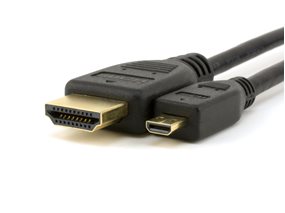
3 Meter (9.84 FT) High Speed HDMI to Micro HDMI D Cable with Ethernet
Frequently asked questions
What is an HDMI cable used for?
HDMI (High-Definition Multimedia Interface) cables carry digital video and audio over a single connector between devices like computers, media players, game consoles, and TVs or monitors. HDMI is the standard connection for most modern home theater and computer display setups.
What's the difference between HDMI, Mini HDMI (Type C), and Micro HDMI (Type D) connectors?
HDMI Type A is the standard full-size connector found on TVs, monitors, and most desktop equipment. Mini HDMI (Type C) is a smaller connector used on some cameras, camcorders, and tablets. Micro HDMI (Type D) is smaller still, commonly used on smartphones, compact cameras, and some tablets. All three carry the same HDMI signal, just through different-sized connectors.
What does "High Speed HDMI with Ethernet" mean?
High Speed HDMI cables are rated to carry higher-bandwidth signals, including 1080p and higher resolutions. The "with Ethernet" designation means the cable includes an additional data channel (HEC) that can share a network connection between two HDMI Ethernet Channel-compatible devices, though this feature is rarely used in most home setups.
Do I need an HDMI 2.0 cable for 4K video?
For reliable 4K video at higher frame rates and with HDR, an HDMI 2.0-rated cable with sufficient bandwidth (18 Gbps) is recommended. Standard High Speed HDMI cables not rated for HDMI 2.0 may still pass a 4K signal in some setups, but are not guaranteed to support the full 4K feature set, including HDR and ARC.
What's the difference between HDMI 1.4 and HDMI 2.0 cables?
HDMI 1.4 supports up to 10.2 Gbps of bandwidth, sufficient for 1080p and basic 4K at lower frame rates. HDMI 2.0 supports up to 18 Gbps, enabling 4K at higher frame rates, HDR, wider color depth, and more audio channels. Both use the same physical connector, so an HDMI 2.0 cable is backward compatible with older HDMI 1.4 equipment.
Are HDMI and DVI signals compatible?
Yes, for video. HDMI and DVI-D both carry the same underlying digital video signal, so an HDMI-to-DVI-D cable or adapter allows a source and display with different connector types to work together. DVI does not carry audio, so audio must be routed separately when connecting HDMI to DVI-D.
Does a lower AWG number mean a better HDMI cable?
Yes. AWG (American Wire Gauge) is inversely related to wire thickness — a lower AWG number means a thicker conductor. Thicker conductors generally maintain better signal integrity over longer cable runs, which is why premium and longer HDMI cables often use a lower AWG than shorter, standard cables.
Does HDMI cable length affect signal quality?
Longer HDMI cables can be more susceptible to signal degradation, especially at higher resolutions and bandwidths. Well-constructed cables with adequate shielding and wire gauge can reliably carry a full signal over common lengths (up to 50 feet or more), but for very long runs, an active or amplified HDMI cable may be necessary.