When talking about cable
pinouts we often get questions as to the difference
in Straight-through, Crossover, and Rollover wiring of cables and the intened use
for each type of cable.
These terms are referring to the way the cables are wired (which
pin on one end is connected to which pin on the other end).
Below we will try shed some light on this commonly confused
subject.
Straight-Through Wired Cables
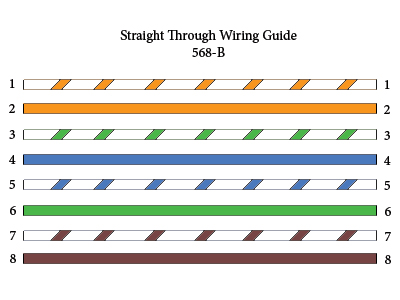
Straight-Through refers to cables that have the pin assignments
on each end of the cable. In other words Pin 1 connector A goes
to Pin 1 on connector B, Pin 2 to Pin 2 ect. Straight-Through
wired cables are most commonly used to connect a host to client.
When we talk about cat5e patch cables, the Straight-Through
wired cat5e patch cable is used to connect computers, printers
and other network client devices to the router switch or hub
(the host device in this instance).
- Connector A
- Pin 1
- Pin 2
- Pin 3
- Pin 4
- Pin 5
- Pin 6
- Pin 7
- Pin 8
- Connector B
- Pin 1
- Pin 2
- Pin 3
- Pin 4
- Pin 5
- Pin 6
- Pin 7
- Pin 8
Crossover Wired Cables
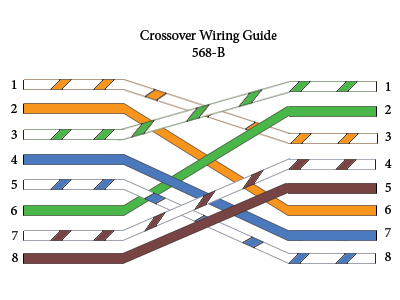
Crossover wired cables (commonly called crossover cables) are very
much like Straight-Through cables with the exception that
TX and RX lines are crossed (they are at oposite positions
on either end of the cable. Using the 568-B standard as
an example below you will see that Pin 1 on connector A
goes to Pin 3 on connector B. Pin 2 on connector A goes
to Pin 6 on connector B ect. Crossover cables are most commonly
used to connect two hosts directly. Examples would be connecting
a computer directly to another computer, connecting a switch
directly to another switch, or connecting a router to a
router. Note: While in the past when connecting two
host devices directly a crossover cable was required. Now
days most devices have auto sensing technology that detects
the cable and device and crosses pairs when needed.
- Connector A
- Pin 1
- Pin 2
- Pin 3
- Pin 4
- Pin 5
- Pin 6
- Pin 7
- Pin 8
- Connector B
- Pin 3
- Pin 6
- Pin 1
- Pin 7
- Pin 8
- Pin 2
- Pin 4
- Pin 5
Rollover Wired Cables
Rollover wired
cables most commonly called rollover cables, have opposite
Pin assignments on each end of the cable or in other words
it is "rolled over". Pin 1 of connector A would be connected
to Pin 8 of connector B. Pin 2 of connector A would be connected
to Pin 7 of connector B and so on. Rollover cables, sometimes
referred to as Yost cables are most commonly used to connect
to a devices console port to make programming changes to
the device. Unlike crossover and straight-wired cables,
rollover cables are not intended to carry data but instead
create an interface with the device.
- Connector A
- Pin 1
- Pin 2
- Pin 3
- Pin 4
- Pin 5
- Pin 6
- Pin 7
- Pin 8
- Connector B
- Pin 8
- Pin 7
- Pin 6
- Pin 5
- Pin 4
- Pin 3
- Pin 2
- Pin 1
Build Cat5e Patch Cables
Within this "How To" article we have included all the information you should
need to find the materials, tools, and info on how
to build straight through CAT 5e Patch Cables and
Crossover CAT 5e Patch Cables. We will discuss materials
needed, cable preparation, as well as connector
termination. Large detialed photos assist in the
learning process.
How to Make Your Own Patch Cables
RJ-45/11 Ratchet Crimp Tool
The CRT-1145P from Secure™ Cable Ties will make terminating RJ-11/45 cables a snap. This model features a lightweight steel frame this is both compact and durable. The CRT-1145P also features a ratchet system which makes repetitive terminations quick and easy. Save some time and money by keeping this crimp tool close by for any projects that may come up in the future.
|
Stewart Cat5e Modular Connectors - RJ45 - 25 pack
Stewart CAT5e Modular Connectors - RJ45 - 25 pack are the perfect for building custom length Cat5e network cables. Our modular CAT5e connectors are manufactured from a clear poly-carbonate and built to withstand everyday abuse. With our quality Stewart Connectors you can expect error free data transfer. Staggered connectors help maintain data integrity and cut down on cross-talk by using a One Up, One Down style that keeps the conductors seperate and maintains the recommended twist throughout the connector. Cat 5 e cable is an enhanced version of Cat 5 that adds specifications for far end crosstalk. It was formally defined in 2001 as the TIA/EIA-568-B standard, which no longer recognizes the original Cat 5 specification. Although 1000BASE-T was designed for use with Cat 6 cable, the tighter specifications associated with Cat 5e cable and connectors make it an excellent choice for use with 1000BASE-T ethernet networks. The 8 Position 8 Contact (8P8C) (often called RJ45) plugs and sockets are most regularly used as an ethernet connector. 8P8C connectors are typically used to terminate twisted pair cable.
|
RJ-45/11 Crimp Tool
The CRT-1145S from Secure™ Cable Ties is a great solution for crimping RJ-11/45 connectors. This deluxe model features a lightweight steel frame that is both compact and durable. The CRT-1145S can handle 8P/8C, 6P/6C and 4C connectors. Keep this crimp tool from Secure™ Cable Ties close by for all of your network installation needs. The CRT-1145S can also save you time and money by allowing you to terminate your own cables to the exact lengths you need.
|
Deluxe Stripper Tool
Stripper Tool, UTP-coax combo deluxe. This deluxe combo stripper tool is designed to strip virtually any cable type of your choice for voice, data, security, audio or video needs within structured cabling.
|
Economy Stripper Tool
Stripper Tool, UTP-STP-110 combo. This multi-purpose economy cable stripper is a versatile product for cable preparation. a strip length gauge allows the removal of a wide variety of jacket materials for utp and stp cables.
|
|